See the flow before the trade
Today we learn about a need when the client calls. Tomorrow we see upcoming invoices, open positions and forecasted currency needs, currency by currency.
 ×
×
Spreads compress. The dealer relationship commoditises. Competitors are building their software layer. An FX provider without one becomes a pipe. Monex gets a white-label FX risk platform under its own brand, connected to each client's bank accounts and ERP, priced with Monex rates through our API.
Today we learn about a need when the client calls. Tomorrow we see upcoming invoices, open positions and forecasted currency needs, currency by currency.
A spread retains no one. A client whose ERP and bank accounts are connected does not switch counterparty over two basis points.
Every commercial conversation starts from client data, not from a cold call.
Monex brand, Monex rates through our API. Client front end and Monex back office.
Future FX impact · upcoming FX transactions · estimated future flows by currency · forecasted needs and hedging opportunities, currency by currency · forward position monitoring · volatility scenarios and stress testing · invoice-by-invoice breakdown.
Invoices, cash flows, open positions and available cash, normalised by currency, counterparty and maturity.
Open banking across Europe and the UK, 300+ financial institutions and 1,000+ connections, plus 40 ERP and accounting systems. The client connects once.
The Monex white-label front end, running on live client data.
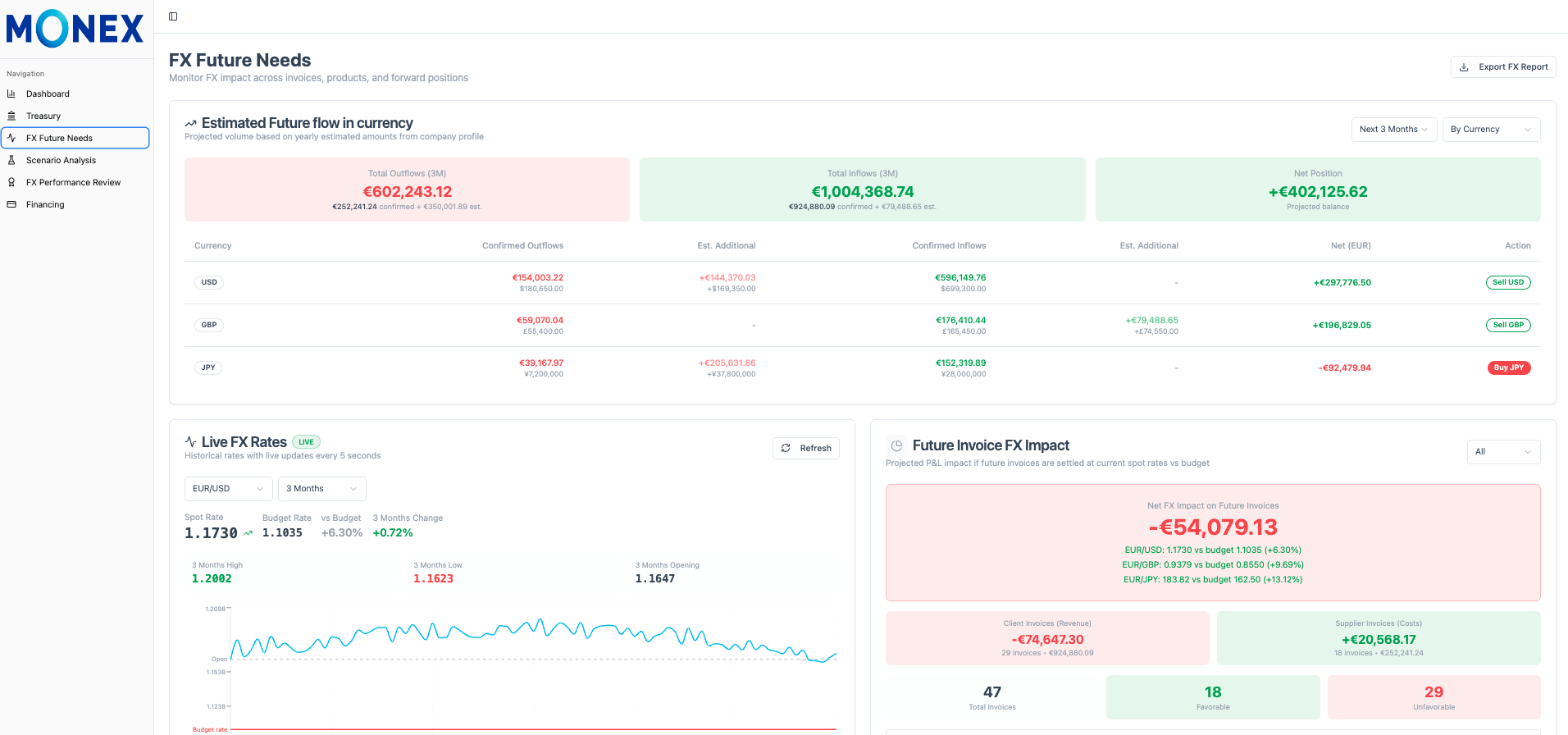
For each connected client, the same view the client sees. Dealers and clients read the same numbers, on the same screen. Above it, four things the desk does not have today.
By currency and maturity bucket, across all connected clients. Where demand will come from, before it arrives.
Who is exposed and uncovered. A commercial priority list that generates itself.
30, 60, 90 days, out to 12 months. A forward view of flow, not a report on last month.
Because the client's accounts are connected, we see the whole of their FX activity. The part that runs through Monex, and the part that does not.
A dealer calls a client with a rate and hopes the timing is right. The conversation is about price, because price is the only thing on the table.
The dealer opens the book, sees which connected clients have uncovered exposure maturing in the next sixty days, in which currency and for how much, and calls with a reason. The client opens the same screen and sees the same numbers.
Everything on this platform depends on one thing: getting a client's real financial data in, automatically, and keeping it current. That is the part that takes years to build. It is done.
More than 1,000 individual connections, covering bank and payment accounts through open banking. Including Deutsche Bank, HSBC, BNP Paribas, ABN AMRO, Ebury and iBanFirst.
Including SAP, Oracle, Microsoft Dynamics and Sage. This is what makes invoice-level analysis possible.
Europe and the United Kingdom are covered today. Two markets remain.
Connect a data provider. Partner identified.
~3–4 weeks of API integrationConnect a data provider. Partner identified.
~3–4 weeks of API integrationTwo candidates, both ready to plug in. Which ones get built, and in what order, is Monex's call.
Invoices, maturities, counterparties and idle cash by currency. Not only FX analysis.
Tulyp's original business, already in operation, with broker registration in place in France. Partner financiers carry the balance sheet risk. Monex earns origination commission without taking credit risk, on clients whose invoices and maturities we already see. France first, because we already operate there. Wider after.
~3–4 weeks to plug inThe platform already knows which cash sits idle, in which currency, for how long. That is the placement trigger. Monex earns margin on placement, and client cash stays inside the relationship instead of leaving for a bank.
~3–4 weeks to plug inMonex is not short of ideas. Testing them is what costs. Inside a forty-year-old institution with 46 offices, a new offering means an IT programme, a core system change and a budget cycle before anyone learns anything.
The structure is built and live. Testing a new offering means connecting it. Launch to a subset of clients. See real usage before committing. Drop what does not work. Scale what does.
On 11 September, Monex has a white-label FX platform live across its European and UK client base.
Underneath it, Monex has a structure. Connectivity, data, analytics, distribution, under the Monex brand, already running. New countries connect to it. New products connect to it. New offerings get tested on real clients before anyone commits a budget.
This is where Monex serves its FX clients better, and where it finds out what to sell them next.
×